
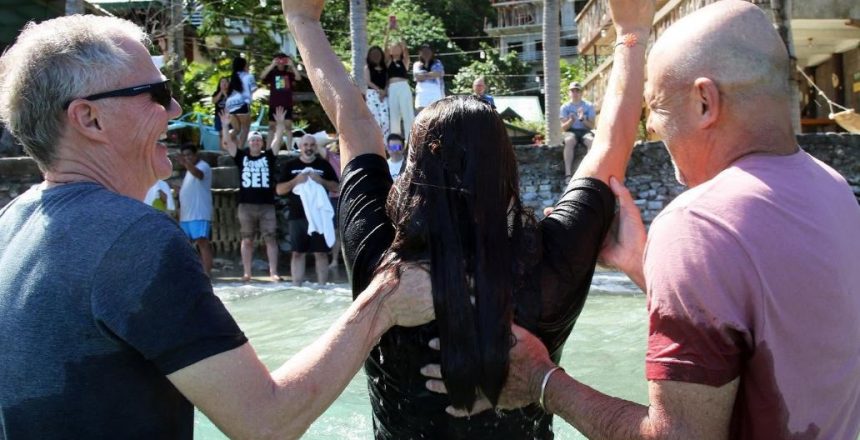
A young, formerly trafficked Filipina woman comes up out of baptismal water with her arms raised for the victory, cleansing and salvation she received through Jesus. Kenny Sacht of Wipe Every Tear is on her left and a pastor from Arkansas, Mike Moore, is on her right. (Photo provided by Kenny Sacht)
By Steve Bertel
(Editor’s note: This is the second installment of a two-part article. If you missed Part 1, you can read it now on our website: www.christianlivingmag.com.)
As a high school teacher and basketball coach at Boise’s Cole Valley Christian School, Kenny Sacht (pronounced “sacked”) enjoyed occasionally taking his students on sports camps/mission trips to the Philippines.
The first, in 2007, was a basketball camp. “Kids there love basketball; it’s the #1 sport,” he said. “In general, Filipinos are very poor people. So, we figured bringing in American high school students who are 6’5”, 6’6”, 6’8” would be quite a big deal for them.”
It was. They held a week-long basketball camp in the city of Manila, combining the popular sport with sharing the Word of God. “Many [of the young boys who attended] were living in slums with their families, since hunger and poverty are really rampant in the Philippines,” Kenny explained. “We also provided them free meals every day. Many of the people there don’t even eat one tiny meal a day. Some don’t eat for days. … Plus, we gave each kid in our basketball camp a free pair of new tennis shoes, since many kids over there don’t even have shoes to wear, let alone new ones.”
The second trip, in 2008, was a two-week girls’ volleyball camp. “That’s when I first got a real feel for the poor,” he said. “One like I never had before.” During the camp, he talked with a young woman who said she and her family only had a small handful of rice to eat every day. Plus, she complained of her mouth hurting. Come to find out, with no available dental care, she was suffering from 27 painful cavities. “It was then when God showed me Revelation 21:4 that says, ‘He will wipe every tear from their eyes. There will be no more death or mourning or crying or pain, for the old order of things has passed away,’” Kenny went on. “And God said to me, ‘You know, I’m going to wipe away every tear on my side of Heaven. I want you to begin wiping away tears on your side of Heaven. And I want you to begin with her.’”
So Kenny and his wife became regular financial supporters of the girl and her family, providing them money for the food and medical care they so desperately needed.
Then, another turning point: after returning home, Kenny found an online article about the Philippines – and how it’s one of the world’s hot spots for prostitution. “I read about girls trapped in the sex trade who were about the same age as my own lovely daughters,” he said. (Kenny and his wife have five daughters and a son.) “And the thought of them being trafficked was more than I could bear. So I told God, ‘Please help me, from here in Boise, Idaho, to set just one girl free.’”
In discussing what he learned with his wife and children, the family soon decided to form a nonprofit group to not only rescue Filipina girls who had been caught up in the snare of sex trafficking, but to show them the life-saving, unconditional love of God.
“Let’s call it Wipe Every Tear!” his wife had chimed in.
So, taking a leap of faith, Kenny resigned from his teaching position in 2012 and, since then, has managed Wipe Every Tear full-time, with he and his family making several trips each year to the Philippines. “We’ve probably made fifty, sixty, seventy trips there since we began,” he said – sometimes with students, sometimes with church groups, sometimes with teams of adults, all of whom faithfully volunteer their time and energies. “Our smallest groups have been about five to six people; our largest was 97,” he added.
According to the 2024 – the most recent – U.S. State Department Trafficking in Persons Report, the Government of the Philippines is continuing “to demonstrate serious and sustained efforts” on cracking down on sex trafficking, which includes investigating and prosecuting alleged traffickers, enforcing and strengthening anti-trafficking laws, “… and sentencing nearly all traffickers to significant prison terms.” According to the agency’s website, most recent figures show “The National Bureau of Investigation (NBI) and the Philippines National Police (PNP) investigated 417 trafficking cases, compared with 277 investigations” the previous year. The government prosecuted 264 alleged traffickers – 217 for sex trafficking and 47 for labor trafficking, compared with prosecuting 139 alleged traffickers – 115 for sex trafficking and 24 for labor trafficking – in the previous [year].”
But, despite those crackdown efforts, sex trafficking in the Philippines still exists. In fact, it blatantly flourishes. Bright neon signs still line city streets, advertising massage parlors, night clubs, dark cyber cafes, and other establishments catering to patrons looking to satisfy their worldly lusts. Why? One word: Corruption. “At a high level,” Kenny said. “Everyone makes money off it. The police, government officials, everybody. The bars have to pay the police, the authorities, and governmental officials. So the sex trade is allowed to happen.”
Kenny described what he and his teams experience firsthand, and their process of saving the young victims. “We go into these tiny, ratty, filthy, hot bars where the girls are being trafficked. I come from a ranching background. When cattle are brought to auction, they’re branded and given a numbered ear tag. And as they’re brought into the corrals for everyone to see and bid on, buyers look at their heads, their eyes, their udders. These girls are treated much the same way; they’re treated just like cattle, like pieces of meat. They each have a number pinned to their clothing, and are forced to walk – paraded – along the elevated bar, sort of a makeshift fashion-show runway, where men – mainly, despicable American men – ogle them up and down, each deciding which one suits his fancy. Like the cattle buyers, the men may say, ‘Oh, I don’t like that one.’ ‘I don’t like that one.’ And, if they don’t find a girl they like, they simply wait for the next batch.”
Most of the women are in their late teens or early twenties. Some are younger. “Several years ago, we brought a girl into our care who was being procured by her own mother, who worked in one of the bars,” Kenny recalled. “That innocent little girl was only twelve years old.” Thanks to the Wipe Every Tear efforts, the girl successfully left the muck and mire of the sex trafficking life behind her and recently graduated from high school.
On each trip, Kenny and his teams spend about ten days rescuing young women and introducing them to the love of Jesus. “Sometimes, we go to the bars in Manila; but mostly, we go to [nearby] Angeles City, known by many as the sex tourism capital of the nation,” Kenny said – or, as he calls it, “The Third World Vegas.” There’s hunger, filth, and poverty seemingly everywhere. Some areas even smell like open sewers.
“For safety, we go into the bars in teams of five, six, or seven people. We offer everyone free hot meals – the bartenders, the waitresses, the bouncers, and especially the lovely girls,” he explained. “In fact, many of the bars’ employees have come to know me of a first-name basis!
“Some bars may have 20 girls ‘working’ in them at any given time; others may have 200. Then, once we locate a young woman we know we can help, we’re ‘required’ to buy her a drink – Coke, lemon juice, beer, or whatever – and ‘pay for her time’ with us. We usually invite her to join us at our table, which gives us the opportunity to spend time talking with her. Then we hand the women flyers, inviting them to join us for a lavish, all-you-can-eat buffet banquet in a few days,” he said. “The girls we approach are either working in the bars for their ‘managers’ – their pimps – or are lone streetwalkers.”
Which begs the question: Have the WET volunteers ever been harmed or had their lives threatened, since they are boldly cutting in on the “managers’’ sources of income? “Actually, no,” Kenny answered. “God has been very good in taking care of us, guarding us, putting a hedge of protection around us, while we are doing His work.”
“Doing His work” usually entails the teams working in the bars and cafes from roughly 9 p.m. to about 2 a.m., the peak times the women make themselves available for men who are trolling. “Sometimes, we work longer. In fact, sometimes we have stayed up all night long to help these girls,” Kenny pointed out.
Then, at the catered banquet, “We worship with the young women, we show them some videos as to what our organization is all about, I get up and address the group (as the WET CEO and founder), then we have a Filipino pastor speak to them in their native Tagalog language,” Kenny explained. “In short, we share the love of Jesus with them; we show them salvation, and the hope that lies within us.”
From there, the team invites the women to what’s called a “Girls’ Getaway” – a four-day/three-night vacation, so to speak, at a nearby resort island – where, Kenny pointed out, “The girls get to swim in the ocean, they get to sleep, they get to rest and relax, all in a very serene atmosphere.” A far cry from the harsh, dirty, rough street life they were used to. “And we have ministry time with them. That’s when God really touches them. In fact, after that, many women then say, ‘I’m ready to give my heart to the Lord,’” he added. “When they do that, we hold baptism ceremonies right on the beach, baptizing them in the waters of the South China Sea … and help them celebrate their new lives with the Lord.”
Then, under the care of the Wipe Every Tear team, the women are given a secure place to stay at the WET safe house (appropriately called “Hope House”) where they are cared for by the group’s trained, full-time staff. They are fed three meals a day; they’re given a daily allowance, for transportation or personal needs – ranging from lipstick to snacks to new clothes; they’re offered child support, where WET team members step up and sponsor a child; they’re given medical and dental care; and are helped with continuing their education, be it in middle school, high school or college – the WET folks even paying for the girls’ school supplies, “because in the Philippines, you can’t even work at the most menial jobs, you can’t even sell peanuts from a kiosk, without a college degree,” said Kenny.
“We also give them a daily allowance. It doesn’t completely replace what they were earning before, on the streets. But it allows them to save a little money, so they can send money back home to support their families – which is usually why they originally became involved in selling themselves,” he added. “We show them they are valued, they are loved, and that they are God’s precious children. In short, we give them a new life.”
Kenny admitted he’s frequently asked why Wipe Every Tear is working in the Philippines, clear on the other side of the world, when sex trafficking also exists in American cities – geographically closer cities like Las Vegas, New York, or even his hometown of Boise, Idaho. “The answer is simple,” he replied. “God told me to go to the Philippines. He has not yet told me to take Wipe Every Tear to Las Vegas. Or New York. Or Boise. But if the day comes when He does, we certainly will.”
Right now, Kenny is comfortable in knowing he’s at the exact spot where God wants him, evidenced by the countless success stories of young women who lives have been dramatically changed for the better.
As Kenny said, “I get Facebook messages regularly from girls we’ve helped saying, in essence, ‘Dear Coach, How are you? I’m doing fine. I’m writing to thank you again for coming into that bar, inviting me off that stage, and telling me about Wipe Every Tear. Thank you so much for showing me the goodness of Jesus.’”
Another success story involved a young woman Kenny simply called “Denise,” since the names of those Wipe Every Tear helps are never publicly revealed, for safety and security reasons. Like others, Denise was enslaved in the dark and destructive sex-trade world. For a number of years. “But then, after she came into our care, she had a mighty encounter with Jesus,” he exclaimed. “In fact, Denise became so hungry and desirous for the Word of God, she became a voracious Bible reader.” She graduated from college – with honors – earning a degree in tourism. What’s more, she then attended seminary … grew even closer to the Lord … and now, faithfully serves as the pastor of a local church.
Three years ago, Denise invited Kenny and his family to attend her wedding. “She was a gorgeous, beautiful bride,” he recalled. “And then, during the reception, she took the microphone and, after thanking all her aunts, uncles, and other relatives for attending, she pointed to me in the audience and said, ‘And Coach, thank you for coming and finding me. Thank you for all that you’ve done. Thank you for telling me about the love of God.’
“I was so touched, I cried. I lost it. As did she.”
The group takes its name – and direction – from Revelation 21:4; but Kenny said its work is also epitomized by Isaiah 58:6. “… to loose the chains of injustice and untie the cords of the yoke, to set the oppressed free …”
“I’ve been doing this full-time since 2012,” he pointed out, “and I’m still giddy and excited about what God is doing through us, through my family, our missionary staff, and through Wipe Every Tear.”
If you’d like to help support Wipe Every Year, or find out how you can accompany Kenny and his team on one of their overseas trips, you can learn more at the organization’s website: wipeeverytear.org. Or you can call Kenny directly at 208-866-1967.
Steve Bertel is a multi-award-winning professional radio, television, print media, and social media journalist, who retired after a 30-year broadcasting career. Now a busy freelance writer, he released his debut suspense novel, “Dolphins of an Unjust Sea,” available on both Amazon and Kindle. Steve and his wife of 43 years live in Meridian, Idaho. He can be reached at [email protected].