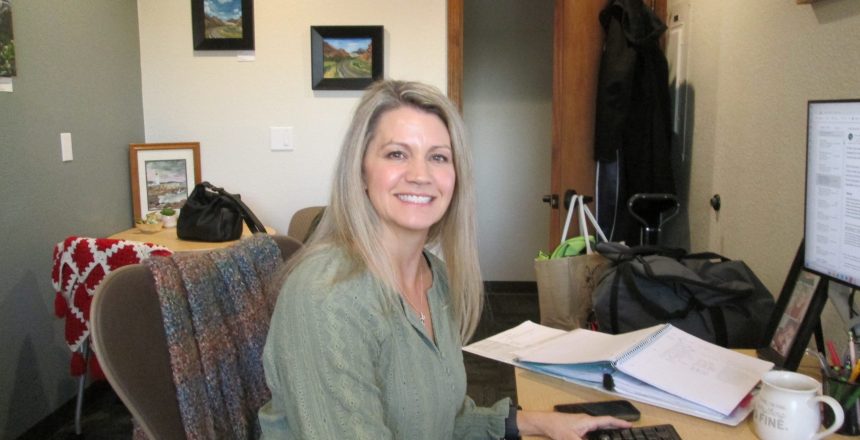
Cari Moodie has served as coordinator of Faith Community Nursing in Idaho for 13 years. She helps match nurses and churches in a health care ministry. She is shown here in her office at St. Alphonsus Health System in Boise. (Photo by Gaye Bunderson)
By Gaye Bunderson
A modern-day nursing specialty harkens back to former days of a faith-based concept known as “parish nursing.” Faith Community Nursing, as it is now more commonly known, involves intentional care of the spirit as well as the body, according to Cari Moodie, coordinator of Faith Community Nursing for the Saint Alphonsus Health System.
“We make sure to intertwine spiritual care,” Moodie said.
A man named Granger E. Westberg developed the concept in the U.S. In 1983 Chaplain Westberg proposed an experimental program to assist with medical crises. He enlisted six Chicago congregations to hire nurses to care for church parishioners, having discovered that nurses made the easiest and most natural connection with the congregants. An ecumenical program from the start, partnerships included three Lutheran churches, two Roman Catholic churches, and one Methodist congregation. (Information taken from https://lutheranfcna.org/History-of-Faith-Community-Nursing.)
A paragraph from the Faith Community Nursing pamphlet helps explain the kind of work the nurses perform: “Faith Community Nurses focus on the intentional care of the mind, the body and the spirit. They promote whole person health and the prevention or management of illness. They also promote the fullness of life that God intends for each individual.”
This is one side of the program. At another, quite literally lower level, the nurses also perform such services as foot care. In this area, they perform the work at Corpus Commons in Boise, a daytime drop-in homeless shelter. FCNs have provided foot care for 107 individuals at local shelters, according to Saint Alphonsus Health System information.
As Moodie put it: “How can you go out and look for work when your feet are hurting?”
Moodie doesn’t see anything the nurses do as menial or trivial. “I really feel like these nurses are answering a higher calling,” she said.
The nurses work in conjunction with churches. “There are currently 90 nurses and health ministries in 20 different churches and health organizations in the valley,” Moodie said.
Moodie said FCN sometimes organizes a “health cabinet” with permission of the church. It is a partnership with members of the congregation; they may visit the sick with a pastor, or alone as a nurse. Along with health care, they may quote Scripture to willing patients, such as 3 John 1:2: “Beloved, I pray that all may go well with you and that you may be in good health, as it goes well with your soul.”
They respect all faith perspectives and will serve the sick with whatever spiritual needs an individual may convey.
Nurse Faith Boyd, who works with Moodie in many capacities, as well as with other local faith-based organizations, explained that people in church who aren’t nurses may participate in the program. “You have to be a registered nurse to be in FCN,” she said, “but churches have lay ministers who can take the FCN training without being a registered nurse; however, their title would be ‘health minister’.”
Boyd explained that FCN is not just about caring for sick people. Members help those in need find community connections and resources; hold blood pressure clinics; provide CPR training in conjunction with the American Heart Association; and teach infant and child care.
Boyd herself has done “a bit of everything,” including hospice, childbirth classes, healthy eating courses, and instruction in the use of therapy dogs.
She stated: “A lot of the nurses are stay-at-home moms – I’m a stay-at-home mom – while some nurses work full-time but also participate in Faith Community Nurses.”
Moodie went to nursing school and started working at St. Al’s because of its emphasis on faith. She has been in her position for 13 years currently, after being asked to help organize a blood drive following time off to raise three children.
A personal emphasis for her is suicide prevention for young people. Since 2015, she has made it a big focus of her work. Moodie even feels it is a special calling, and she utilizes a suicide prevention course churches may offer to their youth groups. She blames social media for the rise in youth suicides because it allows people to pretend they have it all together and their lives are full of only good things, leaving others to feel they can’t measure up to that. St. Al’s has joined Moodie in her effort to prevent suicide.
Faith Community Nurses work – often voluntarily, without pay – in churches, hospitals and health systems, long-term care facilities, community service organizations, and private faith-based schools and colleges.
But while the pay locally is low to non-existent, FCN extols one huge bonus for those who do its work. Job Perk No. 1: Faith community nurses get to incorporate spirituality into their practice more than any other nursing specialties – and FCN is a professionally designated specialty.
Job perks after that include cultivating empathy and reaping the joy of serving God and people. “You’re trained to meet others’ needs,” Moodie said.
For more information, contact Cari Moodie at [email protected].