
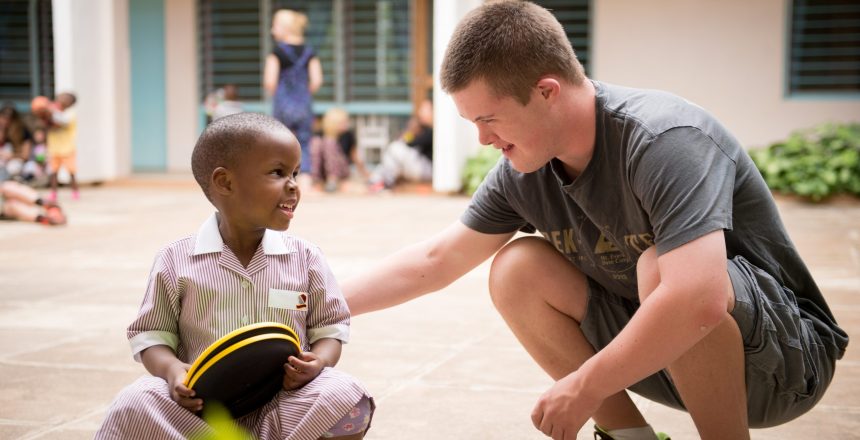
Eli Reimer speaks with an African child in Moshi, Tanzania. The Reimer family hiked a trail in the country to raise awareness for the cause of people with disabilities. (Photo by Benjamin Edwards Photography)
By Gaye Bunderson
A young man named Eli Reimer made his mark on the world in 2013 when he climbed to Mount Everest Base Camp. Far from the first person to do so, his success nonetheless made him the first American with Down syndrome to achieve the goal.
“Eli is an impactful young man,” said Dan Waldeck, Director of Development for Guidelight, a non-profit that helps churches serve people with disabilities. Eli, now 29, is the son of Justin Reimer, who launched the organization in 2005 in Bend, Ore. under the name The Elisha Foundation in honor of Eli. A name change came about when the group was mistaken for a grant-giving organization. Still, Reimer wanted his son’s name included and, looking closely at the word Guidelight, one sees ELI in the middle of the alphabet mix. Also, Guidelight denotes the group’s desire to be a guiding light for those with disabilities and their families.
Reimer said his launch of Guidelight was significantly affected by Eli’s birth.
“My wife Tamara and I were pursuing being missionaries in the former Soviet Union. Then, when Eli was 45 minutes old, the nurse told us he had Down syndrome and needed to be in the ICU.”
After his birth and throughout the subsequent weeks, the couple thought, “We now have to focus on raising a child with a disability.”
So much for their missionary plans, they thought. But it was Reimer’s mom who put the best spin on the situation by saying, “Rather than going on a mission, God brought the mission to you.”
Around this time, Reimer said, two themes emerged.
“When we attended meetings of the National Down Syndrome Society, one thing that stood out was that there was no gospel message there; and many families with disabled children who did go to church were not feeling welcomed.”
Reimer stressed that the latter was not an intentional response on the part of any church, but it reinforced for him the need to open doors to churches where the disabled and their caretakers were given help and a hearty welcome.
“We had to let go of the path we thought God had intended, and we were just discovering the path He was putting us on.”
One thing led to another, and in 2011-2012, the couple launched an outreach ministry for parents with children with disabilities in Ukraine. Stated Reimer: “God was redirecting our thinking. That missionary desire was always with us, and it never left us. God took us to Ukraine, and in 2016, we moved there full-time.”
They lived there until 2022, when Russia launched a full-scale invasion of Ukraine. Reimer himself still visits the country and said he remains very involved there. He explained that he largely feels safe in the war-torn nation because, “I’m not in the trenches.”
It was from Ukraine that the couple launched their global ministry, as God opened doors into other countries. From that vantage point, they were more equipped, Reimer contended, to reach out beyond the borders of the U.S.
When asked about why they wanted a specifically church-based ministry for helping the disabled and their families, Reimer replied: “It is our conviction that the Church is the greatest institution in the world to help foster potential for the best outcomes for transformative good.”
Waldeck got involved in Idaho in Guidelight in January of 2024. Justin is a friend of his, and Waldeck’s motivation also includes the fact he and his wife had a daughter who died at 6 years 9 months of aplastic anemia, a condition in which bone marrow fails to produce enough new blood cells.
“When you go through something like that,” Waldeck said, “life looks a little different than you planned. Your expectations are upended; your hoped-for family life is challenged, turned inside out.”
Waldeck previously served as a Special Olympics coach, and his wife currently serves as Chair of the Special Education Department at Meridian High School. Of his present position as Director of Development for Guidelight, he said: “I’m the relationship guy, and I do whatever’s needed.”
Guidelight specializes in two areas:
“A disability can be at the center of the home,” Waldeck said. In other words, everyone is absorbed by the disability and must devote time to the individual who is experiencing it.
“We want the gospel to be the center of the home,” he stated.
One in five families in the U.S. can be affected by caring for a member with a disability, according to Waldeck, who also explained that surveys indicate that in 95% of churches, people with disabilities and their families are welcome, but only 25% of the churches have ministries directed to help them. He said, “We want to engage the church to walk alongside the family. It’s not Plan B for their lives; it’s Plan A.”
Guidelight holds to the unique, faithful point of view that nothing happens by accident. In defending that position, Waldeck cited John 9:
And as Jesus passed by, he saw a man which was blind from his birth.
And his disciples asked him, saying, “Master, who did sin, this man, or his parents, that he was born blind?”
Jesus answered, “Neither hath this man sinned, nor his parents: but that the works of God should be made manifest in him.
“I must work the works of him that sent me, while it is day: the night cometh, when no man can work.
“As long as I am in the world, I am the light of the world.”
Said Waldeck, “God has designed us – He’s intentional. The weak are indispensable in Scripture.” He explained that in the Bible weakness is portrayed not as a failure but as a position that allows God’s strength to be perfected in a person. Scripture teaches that when humans are weak, frail, or weary, God provides strength, making believers actually strong through reliance on Him.
Examples include 2 Corinthians 12:7-10, which reads in part, “That is why, for Christ’s sake, I delight in weaknesses, in insults, in hardships, in persecutions, in difficulties. For when I am weak, then I am strong”; and Isaiah 40:28-31, “Those who hope in the Lord will renew their strength.”
Another Scripture that could also be included is: God has chosen what is foolish in the world to shame the wise, and God has chosen what is weak in the world to shame the strong. – 2 Corinthians 1:27
Of Guidelight’s efforts on behalf of the people with disabilities, Waldeck stated, “We want to give them biblical hope and practical help.” The group wants to aid their daily needs for respite, friends, and to be known and loved.
“We’re ALL made in the image of God, and people with disabilities have a place and they have something to give to the body. Most churches don’t think they have the bandwidth [to help the disabled]; for us, it’s about changing the disability mindset. It doesn’t have to be a separate ministry – it can be, but it doesn’t have to be.”
Waldeck talked about the agelessness of disabilities, and as an example used “the aging population with its memory issues.”
Disabilities that Guidelight has engaged with have included autism, Down syndrome, and cerebral palsy. Guidelight does not limit the scope of its ministry: “We are ready and willing to engage all of them. It is God’s design that makes these people unique. God is doing something with all of us, if we let Him. His plans are perfect, and we can be a good vessel of His work.”
It is a global ministry and utilizes eight different languages in its work. “We want to introduce Jesus to as many as we can,” Waldeck said, then listing countries and areas such as Madagascar, Slovenia, northern Africa, Columbia, and more.
An estimated 1.3 billion people – or about 16% of the global population – are affected by a serious disability, according to a 2023 study by the World Health Organization. “It is the biggest unreached population in the world,” Waldeck said, “and too many of them are unchurched.”
While he admitted that no one is promised an earthly healing, he used Eli as an example of what people with a disability can do. “He has impacted tens of thousands [with his climbing achievement],” Waldeck stated.
He said that, too frequently, when it comes to interactions with the disabled, people look the other way rather than saying and asking, “We care. Where can we help?”
As for himself, he said the coach in him wants to empower them. His work with Guidelight is a major channel to that empowerment, and the organization hopes to utilize more and more churches to reach its goals. “Churches are a means of reaching out and teaching about care for the disabled and their families.”
Both the disabled and the churches may present a challenge to overcome in that effort. For the disabled, though it is rare, some reject Guidelight’s ideas, opting for a sense of independence and an “I can do this” attitude. Waldeck said that’s fine, but he wants them to know, “Jesus is walking with you, and you can let people walk with you too.”
Guidelight calls and emails churches to tell them, “This is what we do.” But some are not ready yet.
Now is a good time to get ready.
For more information, go to www.theguidelight.org or contact Dan Waldeck at [email protected].